
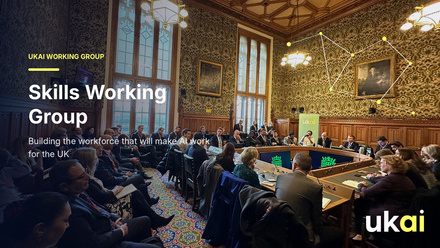
Why This Group Exists
The AI skills challenge is often reduced to a shortage of technical talent. That is only one part of it. The UK needs leaders who can set direction and govern AI, teams able to redesign work around it, specialists who can build and deploy it, and a wider workforce with the confidence to use it responsibly.
Employers are making decisions now about roles, training, investment and workforce transition, while education, funding and skills systems move at a different pace. The result is a widening gap between what organisations need, what learning providers deliver and what policy currently supports. That gap is particularly acute for smaller employers, local economies and people who have least access to high-quality training.
The UKAI Skills Working Group exists to close that distance. It brings together the people shaping demand with the people responsible for delivery, so that AI literacy, professional capability and technical skills are built around real economic need. This is not a general debate about the future of work, and it is not a training marketplace. It is a working group for leaders who want to change how AI capability is understood, funded and delivered across the UK.
The group builds on UKAI's wider work on AI literacy and the UKAI Skills Framework. It treats capability as a system that runs from school and early careers through leadership, workforce transition and lifelong learning, rather than as a one-off course or tool demonstration.
Who’s Involved
Chaired by John Cope, the group brings together leaders who see different parts of the same system. Employers, learning providers, assessment bodies, early careers specialists, workforce leaders and public affairs experts contribute evidence from live decisions about AI adoption, training and talent.
Participation is by appointment, with the group's composition managed to maintain a useful balance between employer demand, education and training delivery, and policy experience. It is designed to be senior enough to influence national decisions and practical enough to test what will work inside organisations.

Greg Freeman

John Cope

Tijs Broeke
What the Group Delivers
The group turns employer evidence into a focused programme of practical and policy work. Its value is cut-through. A route for businesses to influence the skills system, and for educators and policymakers to understand what AI capability looks like in practice.
Members use the group to:
- Define an employer-led baseline for AI literacy that goes beyond learning a particular tool.
- Develop the UKAI Skills Framework into a practical model that leaders, organisations and learning providers can use.
- Create guidance for workforce planning, role redesign, reskilling and responsible AI adoption.
- Shape evidence-led recommendations on the Growth and Skills Levy, apprenticeships, qualifications, curriculum reform and graduate readiness.
- Identify what is holding back adoption inside organisations and what effective training looks like at different levels of the workforce.
- Build models that work for SMEs, regions and communities that are often missed by national programmes.
- Feed directly into UKAI engagement with ministers, Skills England, the Department for Education, local government and the wider skills system.
- Produce reports, case studies, applied use cases, member briefings and member-facing resources that turn insight into usable action.
This is an active working group. Its output is intended to change decisions, improve delivery and give the UK a stronger, more inclusive skills base for AI.
How the Group Works
The Skills Working Group leads a focused programme throughout the year. Activity is practitioner-led, evidence-based and designed around meaningful contribution.
Roundtables & Working Sessions
Focused, private discussions on AI literacy, workforce adoption, and talent pipelines. Built on live evidence and held under the Chatham House Rule for candid member insights.
Collaborative Outputs
Members help shape practical frameworks, guidance, case studies, applied use cases, research and policy papers.
Regional and SME Reach
Surface evidence from SMEs, local authorities and regional economies, and identify practical ways to reach AI cold spots and widen access to high-quality capability building
Policy Engagement
The group develops a consolidated employer voice and brings it into UKAI's engagement with ministers, government departments, Skills England and other bodies shaping education, training and workforce policy.
Strategic Collaboration with Other UKAI Groups
Skills do not sit in isolation. The group connects with UKAI work across working groups and regional chapters so that capability is built into the wider conditions for successful adoption
What’s Coming Up
The first 12-month programme is being shaped around a number of key priorities agreed by the group, that may include:
- The skills base required to support UK AI sovereignty.
- Business adoption of AI and the practical barriers holding employers back.
- Reform of the Growth and Skills Levy and wider programmes so they work for AI training.
- Building responsible AI capability as an area of UK leadership.
- The AI readiness of graduates and school leavers, including curriculum reform.
How to Get Involved
The Skills Working Group is for UKAI members with senior responsibility for learning and development, workforce strategy, talent, apprenticeships, education, assessment, public affairs or organisation-wide AI adoption.
Participation is by appointment so the group retains the right balance of employer demand, delivery expertise and policy perspective. UKAI members outside the core group can also contribute through evidence calls, roundtables, research and practical outputs where their experience is relevant.
If you or your team are dealing with these challenges and want to shape how the sector responds to AI, we would love to hear from you.
For more details, contact Stephen Moore, Director of Membership and Enagagement.